

By Lorenzo Dela Rama
A guest from England arrived at The Peninsula Beverly Hills for a medical procedure and planned to recover at the hotel for several weeks. She had considered bringing her dog, then left it at home. As the days passed, loneliness settled in. The hotel’s response was improbable and entirely sincere: a concierge flew to London, collected the dog and brought it back to Beverly Hills.
Offer Nissenbaum tells the story because it captures the institution he has led since December 2007. “People come here because of how they feel while they’re here,” he said. “It’s the entire guest experience.” Someone noticed a need before it became a service request. That instinct helps explain how a 195-room hotel became part of Beverly Hills culture.
The Peninsula opened in 1991 as the city’s first new luxury hotel in two decades. It has earned many accolades and distinctions every year since 1993. Those honors measure consistency. The richer evidence lives in the human patterns Nissenbaum describes: employees who have worked there since opening, multiple generations of the same families and a repeat-guest rate he places above 70 percent.
“It’s been a love affair,” Nissenbaum said of his 18-and-a-half years at the property. “I love the hotel. It’s part of my family.” He still calls himself an innkeeper, a modest word for a managing director whose influence now extends into civic life. In 2025, he was named chair of the Beverly Hills Chamber of Commerce, positioning him to advocate for local businesses and stronger ties across the city’s hospitality, retail and dining communities.
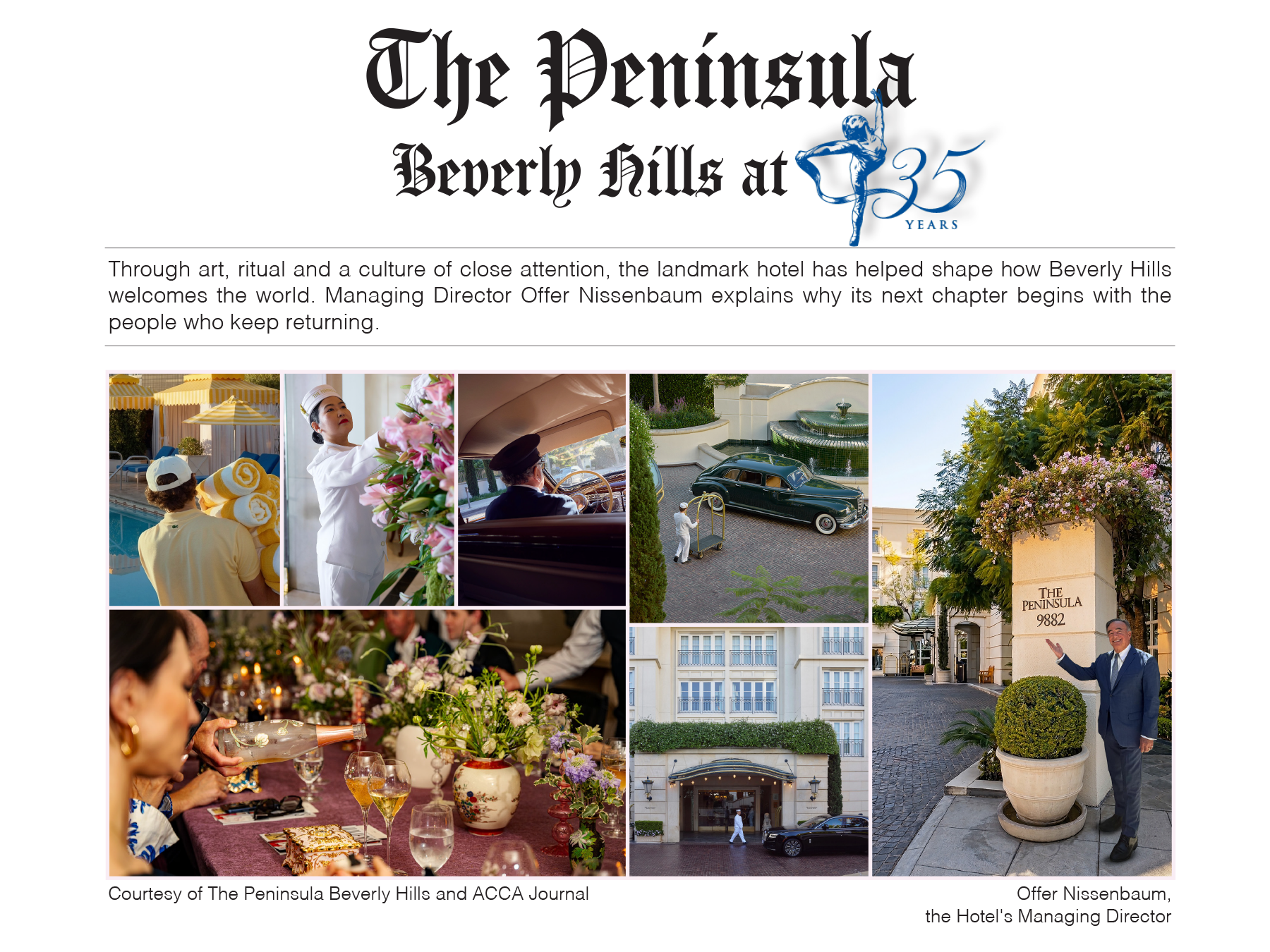
Inside the hotel, culture is carried as much by images and rituals as by service. The Belvedere restaurant holds 11 contemporary works from a personally curated collection, with artists including Yayoi Kusama, Sean Scully, Robert Indiana, Josef Albers, Alex Katz and Nancy Graves. Fabienne Verdier’s commissioned “Linescape I” and “Linescape II” span nine panels around the entrance, made with a brush constructed from 35 horse tails. Dinner unfolds in the presence of abstraction, pop art and postwar geometry; the room gives guests something to discuss after the plates arrive.
Nissenbaum said the collection, lent by the hotel’s locally based managing partner, was intended to become “a talking point and a discussion point” for guests. That choice matters in a city where private collections often remain behind gates. Here, the work enters daily life. The hotel has widened that cultural role through its partnership with Julien’s Auctions, hosting sales connected to figures including Princess Diana, Gwyneth Paltrow and Marilyn Monroe. Fashion, celebrity history and philanthropy pass through the property, briefly turning a hotel into a salon for Los Angeles collectors and the curious.
The 35th anniversary arrives with a physical renewal, but Nissenbaum resisted reinvention. Working with Hirsch Bedner Associates, the hotel refreshed all guestrooms and the rooftop while retaining its French-influenced, residential character. Original Rose Aurora marble vanities and Hampton Hall artwork remained; legacy drapery patterns were reproduced by their original manufacturers. Soft pinks, powder blues and muted greens entered the rooms, while the rooftop gained 10 expanded yellow-and-white cabanas.
“People don’t want us to change things,” Nissenbaum said. “They want us to renew and refresh, but keep the same style, the same feel, the same intimacy.” That philosophy is visible in smaller customs: afternoon tea, monogrammed pillowcases, airport greetings and Peninsula Time, which allows flexible arrival and departure hours based on availability. The hotel is extending the milestone to guests through a 35th-anniversary offer pairing a two-night stay with a $350 hotel credit. It gives the anniversary a lived dimension: time to encounter the dining, rituals and renewed spaces that define the property.
For Beverly Hills, the hotel’s contribution is this blend of international polish and local participation. Nissenbaum speaks of future collaborations with chefs, restaurateurs, fashion houses, jewelers and other businesses that share the property’s standards. He also sees wellness and responsiveness to changing guest expectations as essential to the next era.
After 35 years, The Peninsula’s relevance rests on a deceptively difficult discipline: preserve what people love, notice what they need and leave enough room for the city around it to enter. Art can open a conversation. Tea can become a family ritual. An employee can spend a career learning the faces that return through the door. In a place fluent in spectacle, the hotel’s lasting contribution may be its command of recognition—the feeling that someone remembers you, and that you belong.
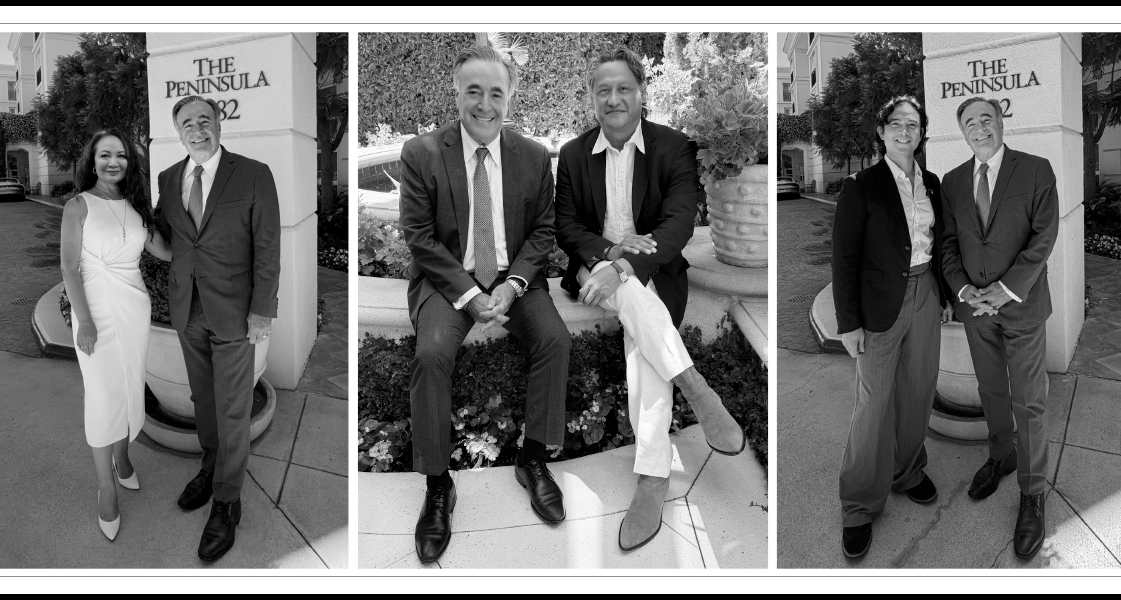
From left to right:
Maya Ito and Carlos Benitez
(ACCA Journal Publishers)
Lorenzo Dela Rama (Writer) with
Offer Nissenbaum
(Managing Director, The Peninsula Beverly Hills)
Carlos asked Offer Nissenbaum
“For The Peninsula’s 35th anniversary, you created a special experience for guests. Was the redesign and refresh of the hotel planned as part of the celebration?”
Offer Nissenbaum
“For our 35th anniversary, we wanted to refresh and renew the entire hotel, including all our guestrooms and suites. As we celebrate this milestone, it is important to preserve the DNA of who we are. When guests return, they do not want us to become a different hotel. They want us to feel renewed while maintaining the same style, intimacy and sense of familiarity.
We have many multigenerational families who continue to return, and for them, staying here feels like coming home. ‘Home away from home’ may sound like a cliché, but in this case, it is true. We try to make every guest feel like they are part of the hotel and welcome them as family. That is the feeling we want to create.”
Maya asked Offer Nissenbaum
“My background is in international business, so I traveled frequently. My first experience with The Peninsula was in Hong Kong, where afternoon tea became a memorable part of the visit. In Beverly Hills, how has The Peninsula carried that tradition forward while contributing to the city’s culture over the past 35 years?”
Offer Nissenbaum
“The Peninsula Hotels share the same culture and approach to service across the group, particularly in how we care for our guests and partners. Afternoon tea has become synonymous with The Peninsula. At each of our 12 destinations worldwide, it remains a signature tradition because guests have come to expect exceptional tea experiences whenever they visit one of our hotels.”
Lorenzo asked Offer Nissenbaum
“Last but certainly not least, as Beverly Hills enters its next chapter—with new development, dining, retail and global tourism continuing to shape the city—what role do you see The Peninsula playing in its future?”
Offer Nissenbaum
“The hotel community as a whole plays an active role in Beverly Hills. It is important that we continue listening to our guests and understanding what they want and expect. As interest in wellness and other meaningful experiences grows, we must adapt to provide the services and experiences people are seeking.
“Listening to our guests, remaining open to suggestions and adjusting our business model will be essential in the years ahead.”

Read Digital Edition | Purchase Physical Edition
ISSUE 30 AVAILABLE
View fullsize
![]()

View fullsize
![]()

View fullsize
![]()

View fullsize
![]()

View fullsize
![]()

View fullsize
![]()

View fullsize
![]()

Quisque iaculis facilisis lacinia. Mauris euismod pellentesque tellus sit amet mollis.